
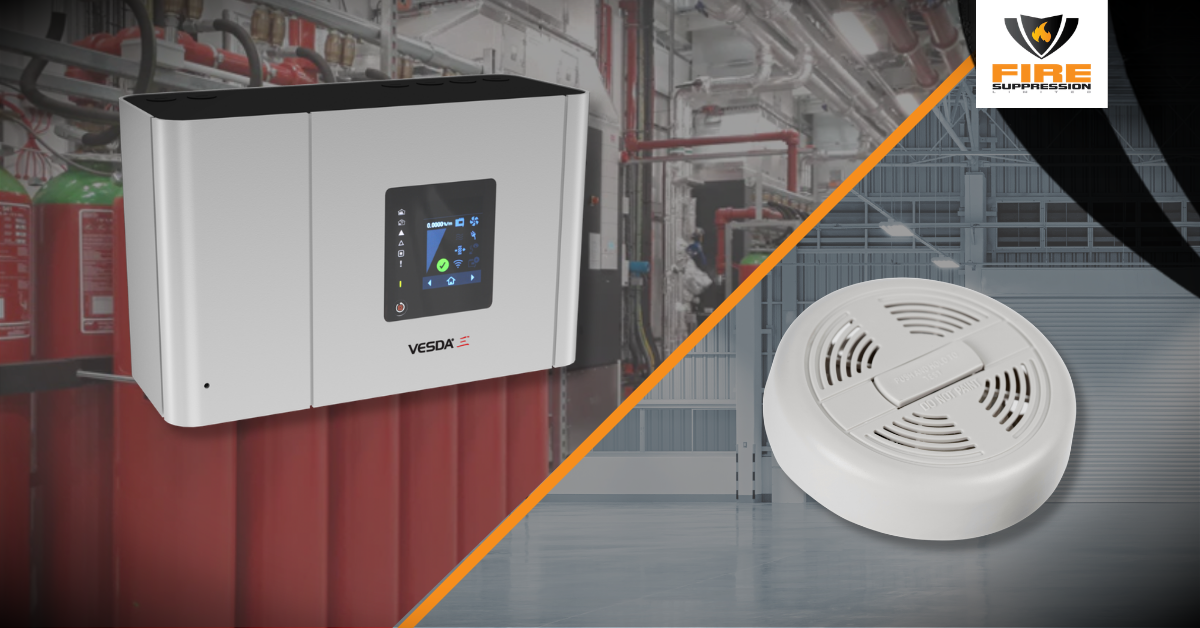
From retail spaces to industrial facilities, buildings need dependable fire detection that ensures the safety of people, property and assets!
Conventionally, buildings use ‘standard point detection’ for their fire safety.
However, more businesses are increasingly using air sampling detection (ASD), which works a little differently – offering a more advanced and reliable sensitive alternative!
As specialists in fire suppression and detection systems, we’re often asked about the difference between the two.
So, we thought we’d explain how they compare and why air sampling detection delivers faster, earlier and more precise fire detection.
What is standard point detection?
Standard point detection systems work by relying on enough smoke contamination over its chamber to trigger the alarm. These are similar to the detectors you’d commonly find in residential properties!
Standard point detection uses individual smoke or heat detectors, typically installed on ceilings or walls, to monitor a specific, fixed location rather than providing coverage across a wider area.
What is air sampling detection (ASD)?
Air sampling detection – also known as aspirating smoke detection or VESDA (Very Early Smoke Detection Apparatus) – are highly sensitive systems that detect early warnings of emerging fire.
These detectors use aspiration (process of sucking in air) to continuously draw air through a network of small pipes installed across the protected area. The sampled air is then analysed by a highly sensitive central detection unit.
This means that ASD systems can identify smoke particles during the very early, pre-combustion stage of fire – often long before visible smoke or flames develop.
If smoke particles are detected, the system can trigger an alarm and/or activate suppression systems immediately!
Why choose air sampling detection / aspirating smoke detection?
Superior sensitivity and early detection
As mentioned, ASD systems can provide very early signs of fire – detecting invisible smoke particles during the pre-combustion phase.
This differs from standard point detection, which relies on smoke from an established fire reaching the main detector head. In some environments – particularly those with high ceilings or strong airflow – this delay can mean an emerging fire goes unnoticed and spreads for several critical minutes.
By identifying fire early, ASD helps prevent fire from escalating, giving personnel enough time to address the incident and for occupants to safely evacuate.
Some advanced ASD systems can even pinpoint which specific pipe in a network has detected smoke, offering similar locating capabilities to standard point systems, but with much higher sensitivity.
Plus, when integrated with an automated fire suppression system, early detection also means suppression can be deployed in a far more controlled and effective manner!
High-performance in challenging environments
Standard point detection does not always operate at full effectiveness in every environment.
Industrial factories or manufacturing plants can be especially hazardous, making the highest level of fire protection absolutely essential!
However, fire detection can be particularly challenging in these conditions as high levels of dust and airborne particulates can contaminate standard point detectors, reducing their sensitivity and increasing the risk of false alarms.
With air sampling detection, advanced filtration and ‘air-purge’ features allow the system to continue functioning in dusty industrial environments.
Standard point detection can additionally face challenges in large open spaces or areas with high airflow.
Because these detectors are typically ceiling-mounted, smoke from an emerging fire may dilute or be redirected by ventilation systems before it reaches the sensor.
However, ASD systems can be configured to sample air strategically throughout large, open-plan spaces, thanks to its high sensitivity and flexible pipe network design.
They also provide a clear advantage in facilities with strong HVAC (Heating, Ventilation and Air Conditioning) or airflow systems. By installing air sampling pipes directly within return air ducts or along airflow paths, smoke can be detected precisely where it travels.
Lower costs, lower maintenance
Although a singular standard point detector may seem ‘cost-effective’ (around £100 to £150 per unit), costs can quickly add up when multiple detectors are required to cover every room, area or space in a facility.
An air sampling detection (ASD) system, on the other hand, requires only one central unit. Using a network of aspirating pipes, a single detector can monitor an entire building or facility
This not only provides a more cost-effective solution to fire detection in a large building, but also enables centralised, streamlined maintenance.
Unlike ceiling-mounted point detectors, which are often positioned in hard-to-access or hazardous areas, ASD units are typically located in safe and accessible locations. This makes routine maintenance (such as filter replacement) easier and reduces system downtime.
Furthermore, many ASD systems have self-checking capabilities, alerting you to any blocked or broken pipes within your network.
Air sampling systems also require less components. Typically, a point detection system will require containment and cabling. In contrast, an air sampling system uses only specialised air sampling pipe, meaning that the carbon footprint of the manufacturing process is likely to be much lower.
Aesthetics and system design
You might assume that standard point detection offers better discretion in a consumer facing environment compared to ASD, which is traditionally made up of red pipes that can be noticeable or distracting within a space.
However, ASD pipe networks can be designed to be aesthetically unobtrusive!
Pipes can be supplied in colours that match their surroundings or can be installed through hidden flush or conical sampling points, blending seamlessly into the environment.
This makes ASD an ideal solution for spaces where aesthetics are critical, such as museums, heritage buildings or high-end architectural sites, delivering advanced fire protection without compromising design.
In summary, while both systems operate effectively, aspirating smoke detection is the preferred solution for identifying and addressing fire risks with greater efficiency, accuracy and reliability.
Fire Suppression Ltd – leading supplier of air sampling detection systems (ASD)
At Fire Suppression, we have over 25 years of experience delivering fire suppression and detection systems, also offering expert consultation, on-site support and comprehensive training to our customers.
Providing regulatory complaint solutions used in diverse applications and sectors, we’ve helped safeguard buildings and operations nationwide – from data centres to retail shopping centres.
In short: whatever you need to protect, our team have the expertise and technology to keep it safe from fire.
